Skip to content

Boat lifts are not all built the same. The capacity rating on the spec sheet is just the beginning. What separates a lift that performs from one that merely holds is how fast it operates, how well it handles the weight of a fully loaded vessel, and whether it was engineered for the environment it actually lives in.
In Florida, that environment is unlike anywhere else in the country. Salt air, intense UV exposure, tidal variation, hurricane season, and some of the highest concentrations of large recreational and commercial vessels in the world. A lift that works in a freshwater lake in the Midwest is not the same animal as a lift that earns its keep on Florida’s Treasure Coast.
This is what high-speed, high-capacity boat lifts are actually about, and why the standard is being raised right here in Stuart, Florida.
A boat worth lifting belongs on a lift worth owning. That is not just a tagline. It is the engineering standard Hurricane Boat Lifts has operated by since 1998.
What Line Speed Actually Means
Line speed measures how fast the lift raises or lowers the vessel, expressed in inches per minute. It sounds like a technical detail, but in practical terms it is one of the most important factors in how a lift feels to use every single day.
A slow lift on a heavy vessel means standing on the dock waiting. For a recreational boat owner who wants to get on the water and back with minimal friction, that wait adds up. For a charter operation or a marina running multiple vessels on a tight schedule, a slow lift is an operational bottleneck that costs time and money on every single cycle.
Why speed matters more as capacity goes up
The higher the load capacity, the harder it is to maintain lift speed. Engineering a motor system and drive components that can move a 20,000 lb or 56,000 lb vessel at meaningful speed requires a fundamentally different level of engineering investment than a standard recreational lift.
Most high-capacity lifts sacrifice speed to manage load. The engineering challenge is closing that gap, building a system that moves large vessels quickly without compromising structural integrity or component longevity.
Line speed is where engineering ambition meets practical daily use. It is the spec that separates a lift you use enthusiastically from one you tolerate.
Load Capacity: Matching the Lift to the Vessel
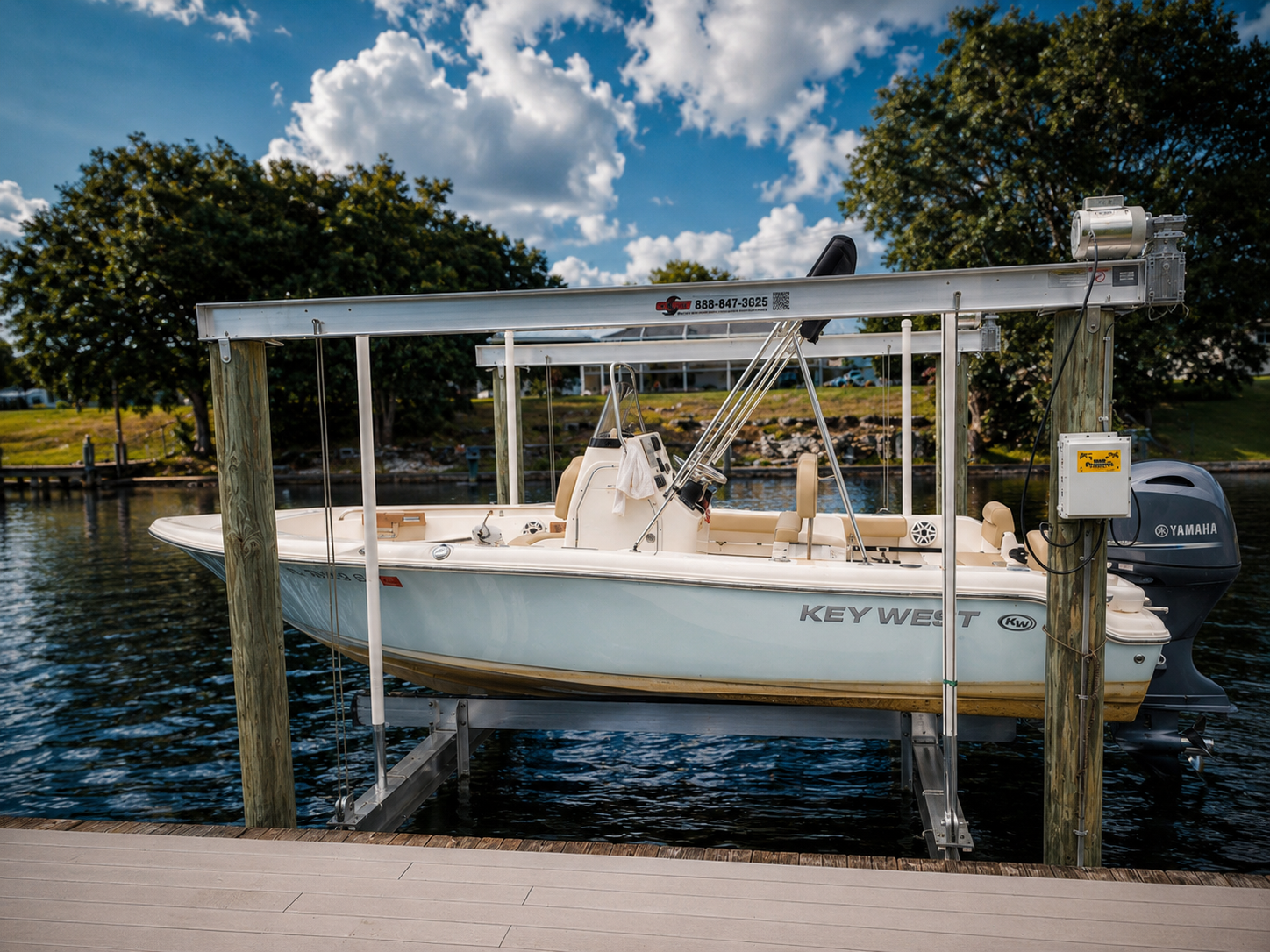
Hurricane Boat Lifts manufactures 10 product lines covering capacities from 1,500 lbs for personal watercraft all the way to 56,000 lbs for the largest vessels in the recreational and light commercial marine market. That range exists because no single lift serves every application, and getting the capacity right matters as much as getting the lift type right.
The loaded weight problem
Load capacity is consistently misunderstood at the point of purchase. Boat owners routinely reference the dry hull weight from the manufacturer spec sheet, which is the weight of the boat with no fuel, no gear, no motor fluids, and nothing on board.
A vessel that weighs 14,000 lbs dry can easily reach 18,000 or 19,000 lbs fully loaded with a full fuel tank, outboard motor, electronics, gear, and a cooler full of ice. Speccing a lift to the dry weight and not the loaded weight puts the lift at or above its design limit from day one.
The rule is straightforward: calculate the actual loaded weight of the vessel in its normal operating configuration, then add a minimum 10 to 15 percent safety margin before selecting a capacity tier.
Hurricane Boat Lifts Capacity Overview
| Lift Type | Capacity Range | Best Application |
|---|---|---|
| PWC / Small Craft | Starting at 1,500 lbs | Personal watercraft and small boats |
| Beamless Lift | Mid-range capacities | Runabouts, center consoles, calm water docks |
| Platform Lift | Mid-range capacities | Versatile, most dock configurations |
| Elevator Lift | Mid to high capacity | Deep water and tidal variation locations |
| Cradle Lift | High capacity | Heavier vessels, premium configuration |
| Storm Series | 4,500 to 13,000 lbs | Value-priced, quick availability |
| Yacht Lift | Large vessel capacity | Yachts, cruisers, wide-beam vessels |
| Boathouse Lift | Varies by configuration | Enclosed boathouse installations |
| Commercial Lift | Heavy-duty capacity | Marinas, fleets, high-cycle operations |
| CAT5-56K Lightning | 56,000 lbs | Largest vessels, fastest line speed available |
If your vessel sits near the top of a capacity tier, move up. The engineering margin is there for a reason, and it protects your vessel, your lift, and your investment.
The Florida Standard: Why Location Changes Everything
Florida is the largest recreational boating market in the United States. It is also one of the most demanding environments a boat lift can operate in. What that means in practice:
- Saltwater exposure accelerates corrosion on cables, fasteners, motors, and structural components at a rate that freshwater environments do not produce
- UV intensity in South Florida and the Treasure Coast degrades materials faster than in northern climates, affecting bunk pads, canopies, and surface finishes
- Tidal variation across Florida’s coastal and intracoastal waterways means lifts are raised and lowered more frequently and across a wider range of water levels
- Hurricane season runs June through November, requiring lift systems built to handle the structural demands of high-wind and surge conditions
- Florida’s boating population skews toward larger, heavier, and more complex vessels, including multi-step hulls, stabilizing gyros, and enhanced electronics that add weight and require more precise hull support
Hurricane Boat Lifts was founded in Stuart, Florida in 1998 with one specific mission: to design and build the highest quality, most attractive lifts at affordable prices. Over 50 years of combined engineering and manufacturing experience have been applied to that mission, producing lift systems built specifically for what Florida demands.
The materials reflect that commitment. Hurricane uses highest-grade aluminum for marine applications, stainless steel cables, stainless steel fasteners, stainless steel motors, and marine-tested gearboxes throughout its product lineup. The company operates its own CNC machine shop, industrial saws, welding shop, and finished lift assembly, controlling every stage of the manufacturing process to maintain quality standards that support warranties unequaled in the boat lift industry.
Engineering a lift for Florida conditions is not the same as engineering a lift and shipping it to Florida. It requires building with the environment in mind from the first design decision.
The CAT5-56K: Where the Florida Standard Reaches Its Peak
The latest product from Hurricane Boat Lifts represents exactly where 25-plus years of Florida-based lift engineering leads. The CAT5-56K 6-Pole is the newest addition to the Lightning Series and the only lift in the marine industry combining a 56,000 lb capacity with a 40-inch line speed per minute.
For boat owners and operators who have reached the limits of what standard high-capacity lifts can offer, the CAT5-56K exists specifically to solve that problem. Larger vessels move faster. Charter and commercial operations run more efficiently. And owners who have been told their vessel is too big or too heavy for a standard lift finally have an answer built for them.
What sets the CAT5-56K apart
- 56,000 lb capacity, covering the full range of large recreational and light commercial vessels
- 40-inch line speed per minute, the fastest available at this capacity in the marine market
- 6-pole configuration for maximum load distribution and structural stability at scale
- Part of the Lightning Series, Hurricane’s high-performance lift line engineered for demanding applications
- First of its kind in the marine industry, developed and assembled in Stuart, Florida
The CAT5-56K is not an upgrade on what existed. It is a lift for applications where nothing existing was good enough.
How to Know If a High-Speed, High-Capacity Lift Is Right for You
Not every boat owner needs a 56,000 lb lift. But every boat owner deserves a lift that is correctly sized, properly speced, and engineered for the conditions their dock actually presents. Here are the questions worth asking before any lift purchase:
- What is the actual loaded weight of your vessel, including fuel, motor, and gear, and does your current or prospective lift have a meaningful margin above that number?
- How many times per week does your lift cycle? For frequent users and commercial operations, line speed has a direct impact on your daily experience and operational efficiency.
- Is your dock in a saltwater, coastal, or storm-exposed environment? If so, material quality and storm ratings are not optional considerations.
- Has your current lift ever shown stress, hesitation, or structural movement under load? That is a signal the capacity or engineering is not matched to what you are asking it to do.
- Are you working with a dealer who has evaluated your dock, your vessel, and your usage pattern, or are you selecting a lift from a catalog?
Hurricane Boat Lifts operates through a network of authorized dealers across the United States. Every dealer is equipped to evaluate your specific situation and recommend the right lift for your vessel, your dock, and your location. For boat owners in the Stuart, Florida area, the showroom at 3301 SE Slater Street is open Monday through Friday, 8:00 AM to 4:30 PM.
Line speed and load capacity are not just numbers on a spec sheet. They are the difference between a lift that works for you and one that simply works. In Florida’s demanding marine environment, that difference is felt every time you hit the water.
Hurricane Boat Lifts has spent over 25 years building lifts in Stuart, Florida that meet the real demands of Florida boating. From 1,500 lb PWC lifts to the new CAT5-56K at 56,000 lbs, the full lineup is engineered with the same materials, the same manufacturing standards, and the same commitment to quality that has driven the brand since 1998.
If you are evaluating a lift purchase or wondering whether your current lift is actually sized for your vessel and your dock, contact Hurricane Boat Lifts or find an authorized dealer near you.
Ready to find the right lift for your vessel? Contact Hurricane Boat Lifts in Stuart, Florida or find an authorized dealer at hurricaneboatlifts.com.