Skip to content
TLDR: Key Takeaways
- Most elevator boat lift clearance plans start with full boat height plus 12″ to 24″ of safety space above the highest water level.
- 6″ to 12″ of horizontal clearance between the hull and the cradle or structure on each side.
- Minimum water depth usually = your boat’s draft plus extra room for the cradle and beams.
- Local water levels, tide swings, and site conditions impact how much clearance you may need.
- The safest way to size an elevator boat lift is to follow manufacturer specifications and have a pro evaluate pilings, seawall strength, and lift angle.
Elevator boat lift clearance isn’t a game of estimations. It’s a serious mathematical calculation that could have safety ramifications if you fudge the numbers. An inch or two off on your measurements can turn a solid lift system into a source of stress, noise, and potential safety hazards. Possibly even a lawsuit if you’re running a business.
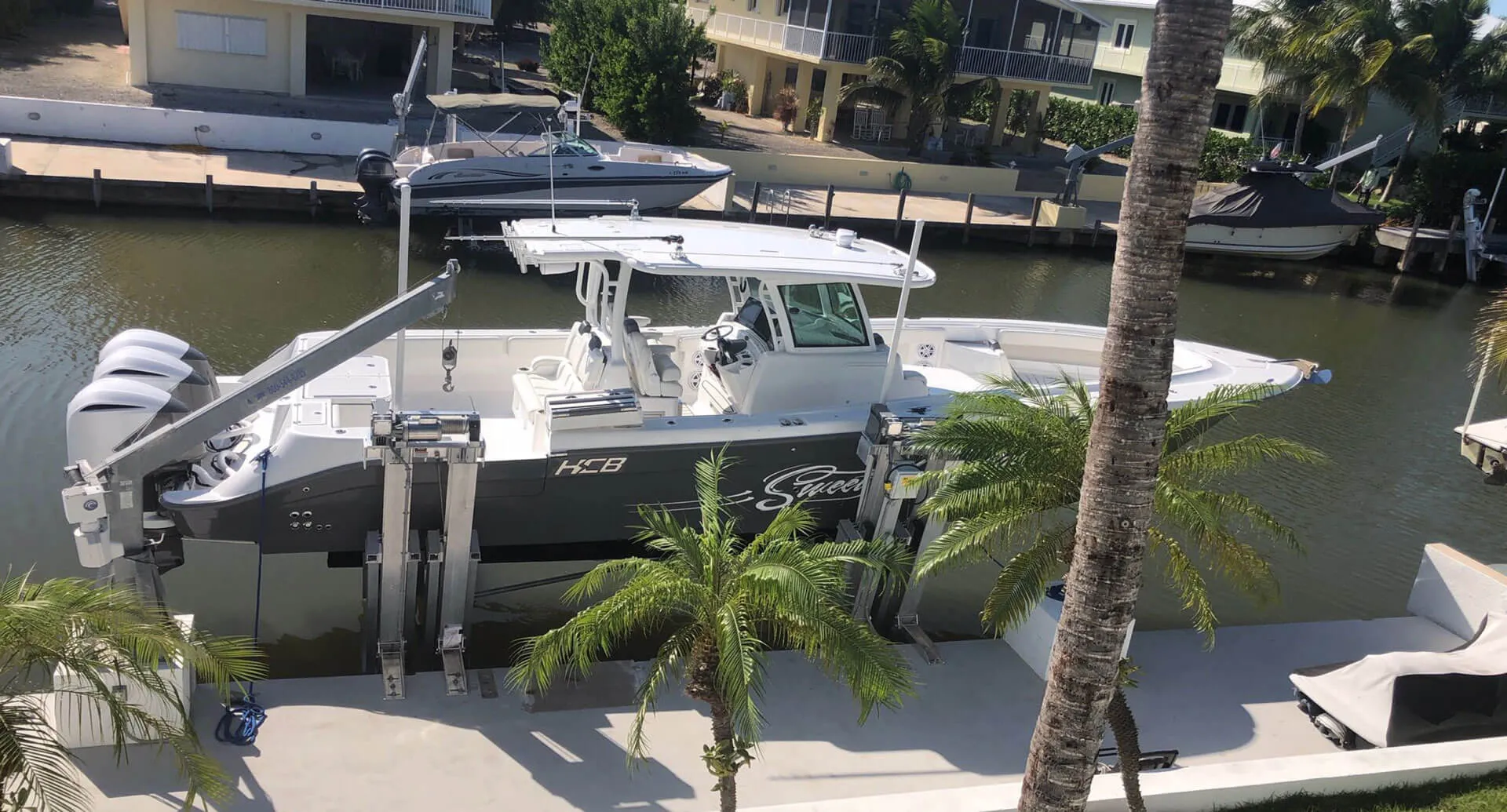
Unlike standard lifts that sit on four posts, an elevator boat lift is a track-mounted lift system that raises and lowers your boat along rails fastened to pilings or a seawall. The cradle is typically suspended on stainless steel cables, driven by a motor and gear system that rides the tracks at a set angle.
Clearance planning has to be spot-on. After all, you’re working with fixed structures, limited space, local conditions (that might include a storm surge, strong currents, or big tide swings), and a lot of weight.
In short, you don’t want to wander into the mysterious white fog, waving a spatula. You need to know the vertical, horizontal, and depth boat lift height requirements, account for your specific boat size and the size of others (if applicable), account for your boat’s weight, and understand a simple clearance calculation before you dive headlong into elevator boat lifts.
You’ll also see when it pays to bring in a professional so your investment in an elevator boat lift maintains peak protective capabilities for your boat, and makes your launch easy and safe. Professional knowledge, in this case, is a win-win scenario.
How Much Clearance Do You Need for an Elevator Boat Lift?
Getting elevator boat clearance right the first time is critical to making sure your boat lift works smoothly every day.
What is an Elevator Boat Lift?
An elevator boat lift is pretty much what it sounds like: a track-mounted lift system that raises and lowers your boat. The system is essentially designed as described in the intro, with rails fastened to pilings or a seawall, a cradle suspended on a cable, driven by a motor and gear system that rides the tracks at a set angle.
You’ll typically spot these lifts on waterfront properties in narrow canals, tight slips, and shallow or restricted areas where traditional lifts simply won’t cut it. They’re different from floating or vertical systems because the platform and boat travel along rigid guides, which is great for smooth operation in limited space. However, your clearance planning had better be on point.
Once you’ve sketched out vertical, horizontal, and depth clearance for your elevator lift, you’re in a much better position to choose the right lift and decide whether your current dock, pilings, or seawall can support it.
Vertical Clearance Requirements
Getting vertical clearance right is just as important as the rest. Your goal is a reliable elevator lift performance, and vertical clearance dictates how high your boat can travel without plowing into the roof, beams, or other overhead structures.
Basic Height Requirements
Here is a good starting point for vertical elevator lift clearance:
- Measure from the water’s surface to the highest fixed point on your boat (rails, towers, antennas)
- Add expected tide or water level fluctuations
- Add a 12″ to 24″ safety margin
For most setups, that puts typical vertical boat lift height requirements in the 6′ to 10′ range above the lowest expected waterline, depending on the boat size and roof/overhead instructions.
Factors that Affect Vertical Clearance
There are several factors you need to consider because they will directly impact your final vertical clearance:
- Boat height, including T-tops, towers, arches, and antennas
- Tide range or seasonal water level shifts
- Total travel distance of the lift from fully down to fully up
- Desired gap between the hull and water to protect against marine growth and wave slap
Safety Buffer Recommendation
Most professionals recommend at least 12″ to 24″ of extra vertical clearance over your calculated minimum. That buffer will help you avoid contact with roofs, beams, or other structures if water levels spike with storm surge, and it leaves room for a slightly taller boat later.
Horizontal Clearance Requirements
Vertical height steals most of the spotlight, but side-to-side and front-to-back clearance are just as important for an elevator boat lift.
Width Considerations
Horizontally, start with your boat’s beam and the inside width of the cradle:
- Aim for 6″ to 12″ of side clearance between hull and cradle or rails on each side
- Tight space makes it more difficult to board and increases the chances of rubbing when the wind or current pushes you off the line
Length Consideration
For length, the lift tracks and platform should comfortably accommodate your boat:
- Allow several inches to a full foot of clearance at both the bow and stern, beyond the farthest points
- If one end of the cradle stops short, make sure swim platforms or outdrives can’t contact the tracks or dock
Dock and Structure Spacing
Keep enough distance between the elevator, boat lift, dock, and seawall to allow:
- Safe access for boarding and line handling
- Room for inspection, lubrication, and other maintenance tasks along the rails and cable paths
Specifically calculating the width, length, and structure spacing around your elevator boat lift provides you with a safer approach, easier boarding, and less cosmetic wear and tear on your hull.
With the horizontal side settled, the next step is to make sure the water depth under your platform is sufficient for a smooth operation.
Water Depth Requirements
Even a perfectly sized lift will struggle if the water depth isn’t right under the tracks and cradle.
Minimum Water Depth
The minimum water depth for an elevator boat lift usually equals:
- Boat draft (keel to waterline)
- Plus cradle/bunk and beam depth
- Plus a small clearance to keep the hull off the bottom at low tide
Many systems can operate in around 2.5′ to 4′ of water depth at low tide, but the real number depends on lift design and boat weight/vessel size.
Seasonal and Environmental Changes
Always size for the shallowest conditions:
- Measure depth at the lowest expected tide or dry season
- Consider sediment build-up, shifting bottoms, and local conditions that can slowly reduce water depth over the life of the installation.
Why Depth Matters for Elevator Lifts
If the water is too shallow, your hull can ground before the lift reaches all the way down, or the cradle can drag, causing strain and safety hazards. For smooth operations, you need adequate depth every time you raise or lower your boat.
Once you know your minimum water depth, you can quickly see whether or not your location is suitable as-is or if you’ll need to adjust lift placement, angle, or even consider different systems for shallow water.
What Affects Elevator Boat Lift Clearance?
For the most part, no two elevator lifts are the same, mostly because of different conditions in different places. Plus, there are a lot of different boats, in terms of weight and size, out there.
Boat Specifications
Your boat itself is the beginning point for your calculations:
- Height, beam, and draft all feed into vertical, horizontal, and depth clearance
- True boat weight must match capacity so the lift can safely support the vessel
Site Conditions
There are a few onsite conditions you should consider, as well:
- Shoreline slope and how far the platform must travel in deep water
- Whether you’re mounting to a seawall or independent pilings
- Water levels and tide swings that affect both depth and vertical clearance
Lift Design and Capacity
Different elevator lifts and configurations change your geometry:
- Track angle and length determine how far and how high the boat travels
- Structural capacity, aluminum beams, and systems layout decide how much weight and which larger vessels you can handle
- Custom lift options may offer a better fit for unusual locations or waterway constraints
When you see how boat specs, local conditions, and lift design all interact, it’s much easier to understand why one waterfront property might work with a standard configuration while another needs a more custom platform or angle.
Can Elevator Boat Lifts Work on Seawalls?
Tight lots and narrow canals might trigger your curiosity in terms of the efficacy of an elevator boat lift mounted directly to your seawall.
Can it be done, or should you go with outboard pilings?
Compatibility with Seawalls
A lot of elevator boat systems are specifically engineered to mount on concrete or reinforced seawall structures. Installers check that the wall can support the combined weight of the lift, boat, and dynamic loads before installation.
Advantages
On tight lots and narrow canals, a seawall-mounted elevator boat lift can be the ideal solution to:
- Sves pilings in the waterway
- Maximizes usable space
- Keep the platform right alongside your dock or wall
Limitations
The primary limitations are:
- Load-bearing capacity of the seawall
- Access for maintenance
- Extra engineering is potentially needed to distribute the forces safely.
In some cases, you may be limited to lighter boats or specific configurations to stay within safe limits.
When it’s the Best Option
A seawall-mounted elevator is often the best fit when you have restricted dock space, property line setbacks, or one end of the canal that’s simply too tight for other lift options.
Clearance Calculation Example
The numbers are clearer when you walk through an elevator boat lift scenario from beginning to end. Plug your measurements into a simple formula so you can see exactly how the height, tide, depth, and safety margins come together and work in tandem for clearance.
Here’s a simple way to determine vertical elevator boat lift clearance:
- Measure boat height (keel to highest fixed point). Let’s say, 9′
- Add maximum tide or water level changes: 2′
- Add a safety margin: 1.5′ to 2′
In this example, you’d plan for about 12′ to 13′ of vertical clearance from the lowest waterline to any overhead structure to comfortably accommodate the boat. A similar step-by-step check for width, length, and water depth helps you confirm the site will fit your chosen lift.
You can use the same process with your own boat measurements and site notes as a starting point before you involve a pro. From there, you’ll be better prepared to avoid the most common clearance errors that crop up during the installation process or the first season of use.
Common Clearing Mistakes to Avoid with Elevator Boat Lifts
Even the most careful boat owners are capable of making mistakes. In fact, there are a few predictable ways you might misjudge elevator boat lift spacing, so write this down and reference it in the future.
- Ignoring T-tops, radar arches, or antennas when measuring your height
- Measuring depth at high tide instead of low, leading to shallow water problems
- Skipping the 12″ to 24″ safety margin for vertical clearance
- Misaligning the elevator tracks with the dock or seawall makes loading more difficult and can shorten lift life.
If you can steer clear of those pitfalls, your lift is far more likely to deliver the smooth operation you’re looking for. There’s only one final piece remaining.
Professional Installation vs. DIY Planning
That final piece is whether or not you want to do the actual work or hire a professional. Or, meet in the middle: do the calculations, design your plan, and hire a professional to check it over and see it through.
Bringing in a pro shouldn’t harm your pride, and it certainly won’t remove you from the process. It does provide you with a partner who can confirm your measurements, cater to your design, check over the structure, and handle the permits.
FAQs
Ready to Calculate Your Boat Lift Clearance?
Getting elevator boat lift clearance right the first time requires more than numbers; this is how you’ll protect your boat, avoid any costly repairs or changes, and enjoy smooth operation throughout the life of the system.
If you’re looking at elevator boat lift options and want to be sure your location, water depth, and structure can safely accommodate your vessel, reach out to Hurricane Boat Lifts today and request a site evaluation or free consultation.
Our team will design the right lift and clearance for your waterfront property, so your lift is sized, installed, and set up to serve you reliably for years.